Royal Society of Literature
The value of great literary bodies to promote national literature has been acknowledged by their universal adoption, and we are not now to dispute the experience of the World." ‘The Royal Academy of Literature’, prospectus, 1820s
The establishment of the Royal Society of Literature was a process rather than a single event. Its earliest, informal foundation can be dated to 2 November 1820, when King George IV gave his assent to a proposal put forward by Thomas Burgess, Bishop of St David’s, for a Society whose aims were ‘the encouragement of indigent merit, and the promotion of general literature’. It was to consist of Honorary Members (‘eminent literary men’ and ‘distinguished female writers’), subscribing members, and Associates (men of distinguished learning and of good moral character), who would be paid 100 guineas a year, 10 funded by the King, and 10 by the Society, as funds permitted. Associates were to produce essays for the Society’s ‘Memoirs of Literature’. The Society would also award annual prizes and hold public meetings (weekly February–July and monthly for the rest of the year).
The prime movers were Bishop Burgess (1756–1837), who had a keen interest in education, and Prince Hoare (1755–1834), painter and dramatist, and a member of several learned societies. The Revd George Croly (1780–1860), author and journalist, was also active in the first few years. A council of the Society began to meet in November 1820, and an account for subscriptions was opened at Hoare’s bank in Fleet Street. The orientalist and biblical scholar Thomas Yeates (1768–1839) was engaged as ‘Provisional Secretary’. In January 1821 the Gentleman’s Magazine announced that the Society was gaining support and funds. A prospectus issued in 1821 expanded on the Society’s aims, to include the promotion of literary education by founding exhibitions at the universities and public schools.
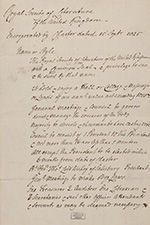
Although by late 1821 there were rumours that the King had lost interest in the Society, in April 1822 Hoare was reassured that His Majesty still favoured the Society and was willing to support it financially. This emboldened the Society to issue another prospectus in May 1822, and to work towards a more formal constitution and regulations. These were laid before the King, and his assent to them was confirmed to Burgess on 2 June 1823. On 17 June the Society held a public meeting, which marked its appearance as a fully-fledged Society, to the extent that its foundation was sometimes attributed to 1823 thereafter. It elected a council and officers (Burgess became President and the Revd Richard Cattermole Secretary), and subsequently printed its first annual Report. In 1824 it issued a volume of containing its Prospectus, Constitution and By-Laws. Finally, the Society was incorporated by a Royal Charter dated 15 September 1825.
This collection has been launched to mark the bicentenary of the incorporation. It consists of the manuscript drafts and copies of early constitutional and regulatory documents preserved in the Society’s archive, which was acquired by Cambridge University Library in 1999. Along with the constitutional documents, the archive consists of membership records; publications; papers relating to meetings, lectures and prizes; financial and property records; photographs; and extensive secretarial correspondence, including files for individual fellows and files arranged by subject.

